






Imagine spending weeks crafting the perfect article. You’ve checked the keyword volume, the difficulty score is low, and your SEO tool tells you it gets 5,000 searches a month. You hit publish, wait three months, and… nothing. A handful of clicks, mostly from your mom and a bot in Eastern Europe.
Now, imagine the opposite. You find a phrase that every major SEO tool—Ahrefs, Semrush, Ubersuggest—claims has exactly Zero searches per month. You write a quick, helpful 800-word piece on it. Within two weeks, your Google Search Console is exploding with impressions, and you’re booking calls with leads who found that specific page.
In 2026, the Volume Chase is a trap. While everyone is fighting over the same 1,000-volume keywords (and getting buried by AI Overviews), the real money is being made in the Zero Volume shadows. This shift is happening because Google now prioritizes intent over raw search volume — something you can better understand through a search intent SEO strategy. This guide will show you how to find these hidden gems and why they are your biggest competitive advantage this year.
What are Zero Search Volume Keywords?

Let’s clear the air: Zero Search Volume (ZSV) doesn’t mean no one is searching for the term. It means no one is searching for it consistently enough for a database to care.
Think of SEO tools like a massive weather station. They are great at predicting a hurricane (High Volume), but they often miss the localized, 5-minute drizzle in a specific backyard.
A ZSV keyword is a hyper-specific, intent-driven query that represents a real human problem. It’s the difference between:
- High Volume: How to lose weight (Broad, competitive, robotic)
- Zero Volume: Can I drink black coffee during a 16-hour fast if I have acid reflux? (Specific, human, urgent)
In 2026, ZSV keywords are the long-tail on steroids. They are the questions people ask when they are tired of generic AI-generated fluff and want a specific, expert-backed answer to a weirdly specific problem.
Why SEO Tools Show 0 Volume While Traffic Still Exists
If people are searching for these terms, why do the world’s best tools say 0? There are three main reasons:
A. The Data Delay
Most SEO tools rely on clickstream data and historical averages (often looking at the last 12 months). If a new trend starts on TikTok today, or a new software bug appears this morning, the tools won’t show volume for it for months. By the time the tool shows 100 searches, the opportunity is already gone.
B. The Threshold Limit
Tools often round down. If a keyword gets 8 searches a month, many tools just display 0 because it doesn’t meet their statistical significance bar. But if you have 100 such articles, that’s 800 highly targeted visitors you’re missing out on.
C. The Variations Problem
People search in infinite ways. Google says that 15% of daily searches have never been seen before. Tools can’t keep up with the unique, conversational way humans talk to AI assistants and voice search in 2026.
How Google Understands Search Intent in 2026

We are officially past the era of “Keyword Matching” In 2026, Google uses Semantic Search and LLM-based interpretation to understand what you mean, not just what you type.
Google now groups keywords into Entities and Intents. If you write an article about “the best way to clean a burnt ceramic pan using only lemons,” Google knows that this is the same intent as “lemon juice for ceramic stains.” Even if the first phrase shows “0 volume,” Google will show your article for dozens of related “Low Volume” phrases because it understands you are the expert on that specific micro-topic.
Why ZSV Keywords are a Hidden Goldmine
If you have a new website, trying to rank for “Best CRM Software” is like trying to win a marathon against Olympic athletes while you’re wearing flip-flops. You won’t win.
ZSV keywords change the game because:
- Zero Competition: Big brands (HubSpot, Forbes, NYT) ignore ZSV keywords because their “Target ROI” doesn’t allow for low-volume topics. They need thousands of clicks to move the needle; you only need ten high-quality ones.
- AI Overview (SGE) Protection: Google’s AI Overviews often answer broad questions perfectly. But for hyper-niche, specific ZSV queries, the AI often struggles or cites a specific expert. By being that expert, you become the AI’s primary source.
- Insane Conversion Rates: Someone searching for iPhone 15 is browsing. Someone searching for iPhone 15 Pro Max screen flickering when using Instagram camera in low light is looking for a solution right now.
Comparison: High Volume vs. Zero Volume Keywords
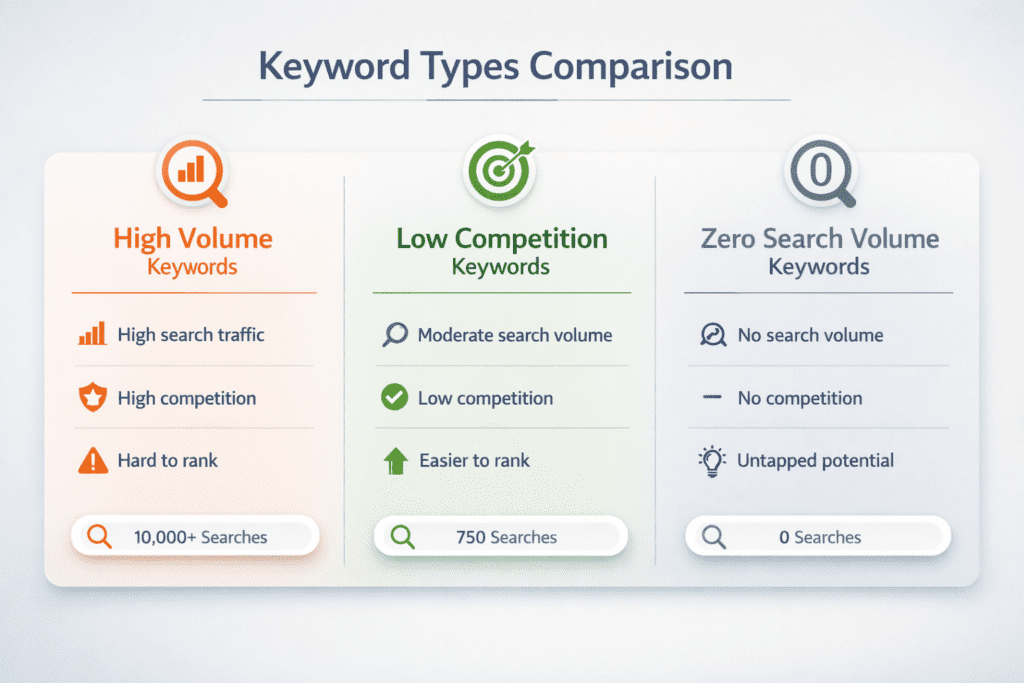
| Feature | High Volume Keywords | Low Competition (LSV) | Zero Search Volume (ZSV) |
| Search Volume | 1,000 – 100,000+ | 100 – 500 | Reported as “0” |
| Competition | Extremely High (Big Brands) | Moderate | Almost Zero |
| User Intent | Usually Informational (Broad) | Specific | Hyper-Specific / Urgent |
| Conversion % | Low (1-2%) | Moderate (3-5%) | High (10%+) |
| Ranking Speed | 6-12 Months | 2-4 Months | 1-2 Weeks |
| Traffic Stability | Stable but declining | Fluctuating | High (but niche) |
Real Examples: ZSV Keywords That Actually Rank
Don’t just take my word for it. Here are examples of what ZSV keywords look like across different niches in 2026:
- SaaS/Tech: How to migrate from Notion to Obsidian without losing nested database relations (Tools say 0; actual traffic is likely 50-100/mo of high-value users).
- Health: Intermittent fasting side effects for women over 50 with hypothyroidism (Hyper-specific, no big medical site covers this exact combination deeply).
- E-commerce: Best eco-friendly yoga mat for people with latex allergies and sweaty hands (This is a buyer ready to purchase).
- Local SEO: Quiet coworking spaces in South Mumbai with high-speed internet and vegan coffee (Specific intent).
The 2026 Method to Finding Zero Search Volume Keywords
Forget opening Ahrefs first. If you want the keywords no one else has, you have to go where the humans are.
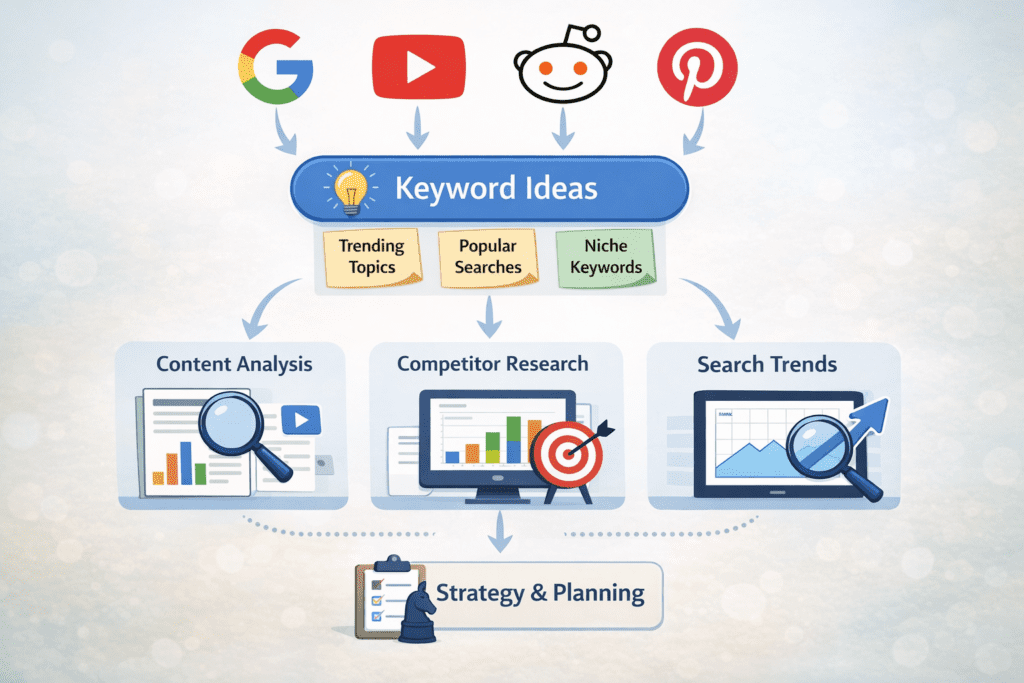
Step 1: Google Autocomplete (The Alphabet Soup Method)
Go to Google, type your main topic, and then start typing “a”, “b”, “c”.
- Search: “Best mechanical keyboard for…”
- Autocomplete Suggestion: “…for lawyers who type 10 hours a day”
- Insight: Tools might say this has 0 volume, but Google is suggesting it because people are typing it.
Step 2: People Also Ask (PAA) Deep-Dive
Search for a broad term and look at the People Also Ask box. Click on a question, and 3 more will appear. Keep clicking until you find questions that are weirdly specific. Those are your ZSV targets.
Step 3: Reddit & Quora (The Complaint Mining Method)
Go to a subreddit related to your niche and search for How do I, Problem, or Help. Look for threads with 50+ comments where people are saying I can’t find an answer to this anywhere. That phrase is your keyword.
Step 4: YouTube & TikTok Comments
People ask the most specific questions in the comment sections of popular videos.
- Video: How to bake sourdough.
- Comment: What if my kitchen is 85 degrees and I’m using rye flour, why is my starter bubbling but not rising?
- Result: That comment is a ZSV article waiting to be written.
Step 5: Pinterest Search
Pinterest is a visual search engine. Its autocomplete often reveals aesthetic or niche needs that traditional SEO tools completely miss, especially in home decor, fashion, and DIY.
How to Validate if a ZSV Keyword Will Actually Bring Traffic
Since you can’t trust the tools, you have to use Manual Validation.
- The Forum Test: Search the keyword. If the top 3 results are Reddit threads or old forum posts from 2019, it’s a goldmine. It means people are searching for it, but no one has written a dedicated, modern article on it.
- The Social Signal: Does the topic get engagement on X (Twitter) or LinkedIn? If people are debating it, they are searching for it.
- The Common Sense Factor: If you are in your industry and you have had this question, or your customers keep asking it, it has volume. Period.
Content Strategy: How to Rank and Convert
Ranking for ZSV keywords isn’t about length; it’s about Precision.
- Don’t write Ultimate Guides: If someone asks for a specific fix, don’t give them 5,000 words on the history of the industry. Answer the question in the first 100 words.
- Use First-Person Experience: In 2026, E-E-A-T (Experience, Expertise, Authoritativeness, Trustworthiness) is everything. Say I tried this, and here is what happened. AI can’t do that.
- Direct-to-Solution: Include a clear CTA (Call to Action) that relates specifically to the problem. If the keyword is about a specific error code, your CTA should be a Troubleshooting Checklist download.
Clustering: The One Article, Many Zeros Strategy
You shouldn’t always write a separate 1,000-word article for every ZSV keyword. Instead, use Clustering.
Group 5–10 ZSV keywords that share the same Parent Intent into one comprehensive article.
- Main Topic: Troubleshooting Ceramic Cookware
- ZSV Sub-headings: How to fix white cloudy stains on ceramic
- “Can you use metal whisks on ceramic-coated pans?”
- “Why is my ceramic pan sticking after only 3 uses?”
By doing this, you build Topical Authority. Google sees that you haven’t just targeted one keyword—you’ve mastered the entire sub-topic.
Mistakes to Avoid (The Beginner Traps)
- Over-Optimizing for One Phrase: Don’t repeat the ZSV keyword 20 times. Write naturally. Google is smart enough to find you.
- Chasing “Dead” ZSVs: Some keywords have 0 volume because the topic is truly dead (e.g., “How to fix iPhone 4 battery”). Ensure the topic is relevant to 2026.
- Forgetting Internal Links: ZSV articles are your feeder pages. They should always link back to your high-volume Money Pages.
Advanced 2026 SEO Tips
- Optimize for SGE (Search Generative Experience): Use clear headers and bullet points. Google’s AI likes to scrape well-structured lists to build its summaries.
- Video Integration: For ZSV How-to queries, embed a 60-second Short or Reel at the top. This keeps users on the page and helps you rank in Video Search.
- Entity Clarity: Mention specific brands, tools, or locations. This helps Google’s Knowledge Graph connect your content to the real world.
Case-Style Example: The Mechanical Keyboard Niche
Let’s say you have a new tech blog.
- Wrong Move: Targeting “Best Gaming Keyboards” (Difficulty 80/100).
- Winning Move: Targeting “How to silence the spacebar rattle on a Keychron V1 without desoldering.”
- The Result: Tools say: 0 Volume.
- Reality: 40 people search this every month.
- Conversion: You recommend a specific $5 lube kit on Amazon.
- Math: 40 visitors/mo x 10% conversion = 4 sales.
- Scale: Do this for 50 ZSV keywords, and you have 200 sales a month with zero competition.
Frequently Asked Questions
Q1: How long does it take to rank for ZSV keywords?
In 2026, if your technical SEO is solid, you can rank on page 1 within 48 hours to 2 weeks. Since there is no competition, Google is happy to test your content immediately.
Q2: Can I use AI to write these articles?
You can use AI for the outline, but the value of ZSV keywords is the specific expertise. If you just publish a generic AI response, you’ll likely get buried. Add your own screenshots, opinions, and “Experience.”
Q3: Is it worth it if I only get 10 visits a month?
Yes. Ten visits from people looking for a specific solution are worth more than 1,000 visits from people looking for free wallpaper.
Q4: Should I still target high-volume keywords?
Yes, but don’t start there. Use ZSV keywords to build authority first. Once Google trusts you as an expert in the niche, it will be much easier to rank for the bigger terms.
Q5: What tool is best for finding these?
Actually, the best tool in 2026 is Google Search Console. Look for Impressions on keywords you aren’t even targeting. Those are often ZSV gems you can turn into dedicated articles.
Q6: Does ZSV work for B2B?
It works best for B2B. Corporate buyers search for very specific technical problems. Solving those problems is the fastest way to build trust and get a lead.
Conclusion: Your Actionable Takeaway
The secret of 2026 SEO isn’t about finding the biggest audience—it’s about finding the unserved audience. By combining manual research on platforms like Reddit with the precision of BizSmartTools, you can build a traffic machine that your competitors won’t even see coming.
Your Next Step: Go to a forum or a subreddit in your niche. Find three questions that have been asked in the last 30 days but don’t have a clear, dedicated article on Google. Write those three articles this week. Ignore the 0 in your SEO tool and watch what happens to your traffic.



0 Comments