






Remember when ranking on Google felt like just sprinkling keywords everywhere? You’d create a 1,000-word blog post, add best SEO strategy five times, maybe get a few basic links, and wait. Sometimes, it actually worked!
But those days are long gone. Today, the game has changed entirely. You probably know this. You might be spending weeks writing detailed, research-backed content, only to see it sit on page 5 or 6, never getting the traffic it deserves. It’s frustrating, isn’t it?
You start thinking, “Why do my competitors always rank higher? Do I need more backlinks? Is my content not good enough?”
While those things matter, the biggest reason for poor rankings in 2026 isn’t a lack of keywords or quality—it’s a lack of understanding Search Intent.
Welcome to the future of SEO, where why someone searches is far more important than what they search.
In this comprehensive guide, I’m going to share my professional experience—no generic advice, no AI fluff—on how to master Search Intent SEO and finally see your content climb the ranks faster.
What is Search Intent?
Search intent (also known as user intent) is the primary goal or reason a user has when typing a query into a search engine.
Simply put, what is the searcher trying to achieve?
Are they looking for information? Do they want to buy something immediately? Are they trying to compare options before making a decision? Or are they just looking for a specific website they already know?
Why Google Cares (And Why You Should, Too)
Google’s entire business model depends on giving users the most relevant answer as quickly as possible. If people can’t find what they need on Google, they’ll stop using it (and maybe try an AI answer engine or another platform).
This is why Google’s algorithms, especially with the advancements in AI and semantic understanding we’ve seen leading into 2026, are obsessed with intent. Keywords are just signals; intent is the context.
If a user searches for chocolate cake recipe, Google knows they probably want a blog post with ingredients and steps, not a page selling pre-made cakes. If you write the best content about buying chocolate cake for that keyword, it won’t matter how great it is—it won’t rank. You’ve misunderstood what the user wants.
When you match search intent perfectly, you are not just pleasing Google; you are solving the user’s problem. Happy users stay longer, engage more, and are more likely to convert. This is why intent is the single most important ranking factor today.
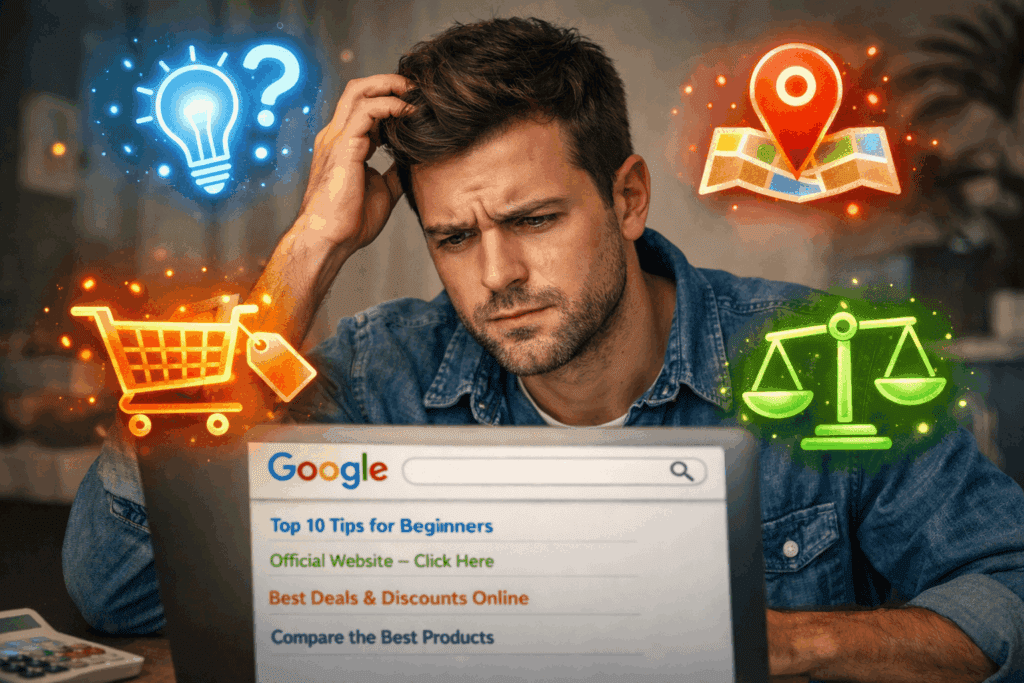
The 4 Main Types of Search Intent
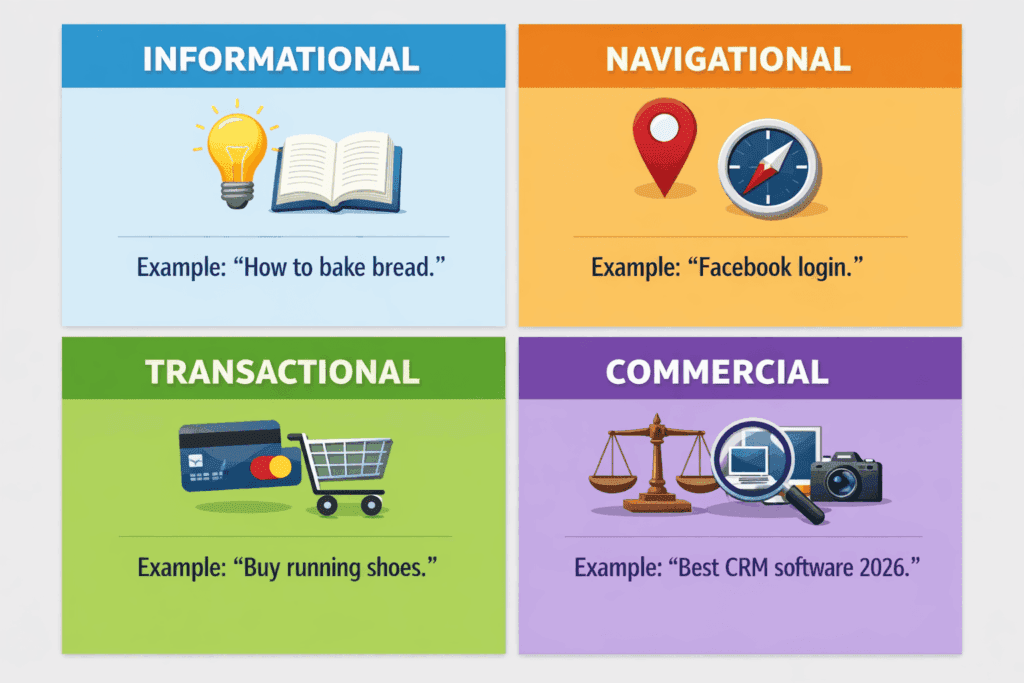
To master Search Intent SEO, you need to be able to categorize queries correctly. Generally, intent is broken down into four key types:
1. Informational Intent
The user is looking for knowledge, answers to specific questions, or a general overview of a topic. This is the know intent. These searchers are not looking to buy anything yet; they are in the learning phase.
- Examples:
- “how to rank on google”
- “what is search intent”
- “python programming tutorial”
- “best time to plant tomatoes”
- Best Content Format: Blog posts, articles, “how-to” guides, wikis, whitepapers, and videos.
2. Navigational Intent
The user is trying to find a specific website or webpage. They already know where they want to go; they’re just using Google as a shortcut.
- Examples:
- “facebook login”
- “seomoz blog”
- “amazon customer service”
- “gmail”
- Best Content Format: Unless you are the brand the user is searching for, this intent is incredibly difficult (and usually not valuable) to target. Ensure your own brand terms lead to the correct landing pages.
3. Transactional Intent
This is the “do” intent. The user has decided what they want and is ready to buy, download, or sign up. These are high-value queries because they are closest to conversion.
- Examples:
- “buy iphone 15 pro max”
- “semrush coupon code”
- “order pizza online”
- “download Adobe Acrobat”
- Best Content Format: Product pages, pricing pages, checkout pages, and service sign-up pages.
4. Commercial Investigation Intent
This is a blend of informational and transactional intent. The user is in the consideration phase. They intend to buy or convert eventually, but they are still researching, comparing options, and looking for reviews.
- Examples:
- “best SEO tools for small business”
- “mailchimp vs constant contact”
- “top rated CRM software 2026”
- “honest review of [Product Name]”
- Best Content Format: Comparison articles (“X vs Y”), “top 10” listicles, detailed product reviews, and case studies.
How Google Understands Search Intent
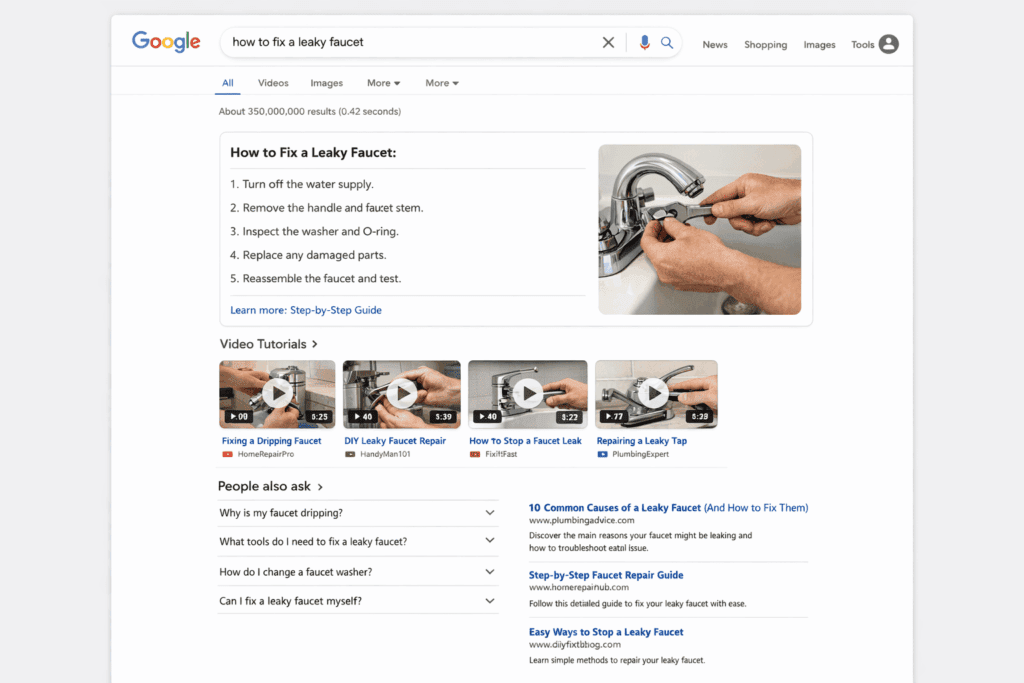
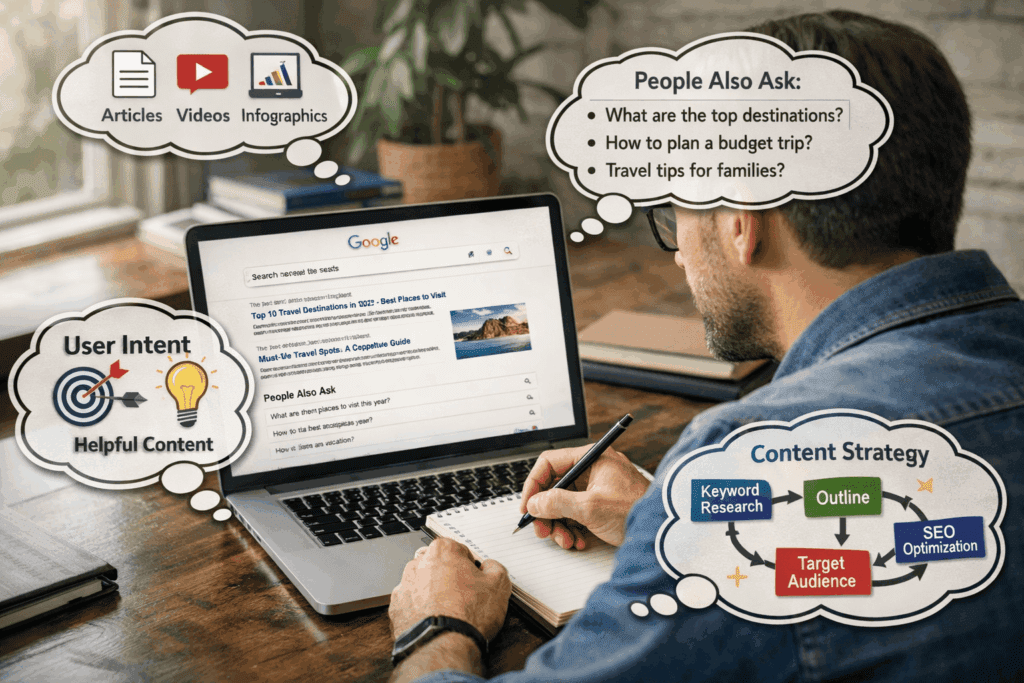
You don’t have to guess the intent of a keyword. Google will literally show you. The search engine results page (SERP) is a mirror reflecting what Google believes is the primary intent behind a query.
Analyze the SERP Behavior
Let’s look at a real-world example: best drone for photography.
In 2026, the SERP for this is not just a list of ten blue links. You will likely see:
- A highly detailed Featured Snippet (likely an AI-generated summary) highlighting the single best option or key comparison points.
- A “People Also Ask” box with related questions like “Is it worth buying a cheap drone for photography?”
- A list of listicles (“Top 10 Drones,” “Best Drones for Beginners”) from tech review sites.
- A prominent Video Carousel from YouTube, showing real-world footage and reviews.
What does this tell you about the intent? It’s strongly Commercial Investigation. The user isn’t trying to buy one specific drone right now (transactional) and doesn’t want to know how drones work (informational). They want to compare and see reviews before they decide.
Look at Content Formats
If you see the top 10 results for a keyword are all videos, you probably shouldn’t try to rank with a text-heavy, 3,000-word article. If the results are all product pages, you shouldn’t try to rank with a blog post.
You must match the format Google prefers for that specific intent.
Featured Snippets and SERP Features
- Featured Snippets (Paragraph/List/Table): Typically indicate informational or commercial intent. Google thinks it can answer the user’s query right on the page.
- Videos: Strong signal for visual informational (how-to) or commercial (reviews) intent.
- Map Pack (Local SEO): Indicates strong local, navigational, or immediate transactional intent (“pizza near me”).
- Shopping Ads: Purely transactional.
By studying these, you can get a cheat sheet for exactly what kind of content Google wants to rank.
Why Most Content Fails to Rank
I’ve seen it time and time again in my SEO career: brilliant content that simply cannot rank. When I analyze it, the issue is almost always a failure to match search intent.
1. You Targeted the Wrong Intent Entirely
Let’s say you are an email marketing software company. You want to rank for the keyword “email marketing strategy.”
You might be tempted to create a feature-heavy page showing off how your software helps with strategy (transactional intent). But a user searching “email marketing strategy” is looking to learn (informational intent). They want tips, templates, and frameworks.
If you don’t provide that educational content, they’ll click your result, realize it’s a sales page, and instantly hit the back button. Google sees this (high bounce rate, low dwell time) and demotes your page.
2. Keyword Stuffing vs. Intent Matching
This is the biggest mistake left over from old-school SEO. You might think, “I need to make sure ‘best SEO tools’ appears 15 times.“
In 2026, this is a recipe for disaster. Google is smart enough to understand synonyms, context, and related concepts. Focus on comprehensively answering the user’s query and covering all the topics related to their intent. If you’re writing about the “best SEO tools,” you should naturally talk about features, pricing, pros and cons, and use cases, which will naturally include the keywords you want to target.
Remember, intent is just one part of the puzzle. To truly rank in 2026, your content must also demonstrate trust and expertise—check out our full Google E-E-A-T Guide in 2026 to learn more.
The Honest Reality
Ranking takes time, but trying to rank without matching intent is simply impossible. You are fighting against Google’s core mission.
The fastest way to rank, counterintuitively, isn’t by trying to trick the system with perfect keyword optimization. It’s by providing the exact type of content and answer the user is looking for, better than anyone else is doing it.
Step-by-Step: How to Use Search Intent SEO to Rank Faster
Let’s get actionable. Here is my exact, step-by-step framework for creating content that matches search intent perfectly.
Step 1: Analyze Keyword Intent
Don’t just pick a keyword based on search volume. Start by searching for your target keyword in Google.
- Look at the ads. If they are mostly shopping ads, it’s transactional. If they are text ads for services, it’s commercial. If there are no ads, it’s likely informational.
- Check the SERP features (as detailed in the “How Google Understands” section).
- Read the actual titles of the top 5 results. Do they say “What is…” (informational), “Best [Product]…” (commercial), or “[Brand Name] Pricing” (transactional)?
Step 2: Study the Top 5 Google Results
This is your blueprint. The sites ranking here are doing something right. Analyze them, but do not copy them blindly. Your goal is to see what Google likes and then do it better.
For each of the top 5 results, ask:
- What is the core answer they provide? Is it a definition, a step-by-step process, a list of product recommendations, or a direct product page?
- What format is the content in? Short article, in-depth guide, video, infographic, or product matrix?
- What related questions are they answering?
- What is the tone? Simple, academic, professional, conversational?
Step 3: Match the Content Format
Once you’ve analyzed the SERP, commit to a format.
- If the top results are “Top 10” listicles, you must write a “Top 10” listicle.
- If they are detailed tutorials, you must write a comprehensive guide.
- If they are concise definitions (common with Featured Snippets), you should probably lead with a clear, concise definition and then elaborate.
Step 4: Cover the Complete Intent
A common mistake is answering the obvious question but ignoring the underlying intent.
If someone searches for “how much does SEO cost,” their direct intent is to find a number. But their underlying intent is likely to understand how SEO services are priced (hourly vs. project), what factors influence cost (industry competitiveness, scope), and how to choose a provider without overpaying.
This is your opportunity to add 10x value. Your content should not only give a pricing range but also explain why it costs that much, what deliverables to expect, and questions to ask potential agencies. This is how you build trust and authority, which are key for SEO in 2026.
Step 5: Optimize for UX and Readability
User experience (UX) is now inseparable from SEO. If your intent-perfect content is buried in a wall of text, users will leave.
- Write simple, human-friendly English. (Exactly what I’m doing now).
- Use proper headings (H1, H2, H3) to structure your content. This helps both Google and users scan your page.
- Keep paragraphs short (2-3 lines max). It’s easier to read, especially on mobile.
- Use bullet points and numbered lists where appropriate.
- Highlight important lines using bold or italic text—but don’t overdo it.
- Add relevant visuals like screenshots, infographics, or charts to break up text.
- Ensure your page loads incredibly fast. Speed is a major UX signal.
Real-World Case Studies
I can talk about intent all day, but nothing proves its power like real examples. Here are two realistic case studies from my experience.
Case Study 1: Transforming a Blog Post
The Problem: An email marketing company wrote a detailed, 2,500-word blog post titled “The Complete Guide to Email Automation Features.” They optimized it for the keyword “email automation.
The Issue: The post didn’t rank because the SERP for “email automation” was dominated by commercial investigation content (like “best email automation tools“) and transactional product pages. The user intent was split, but very few were looking for a long, informational guide on the features.
The Change: The company did a Search Intent SEO audit. They realized they needed to split their approach.
- They created a new, dedicated commercial investigation post: “10 Best Email Automation Tools to Save You Time (2026).” This post featured their own tool but also fairly reviewed their competitors.
- They repurposed the original guide to focus on informational queries like “how to set up email automation” and “benefits of email marketing automation.”
The Result: Within four months, the new commercial post ranked on page 1 for several high-intent keywords, leading to a significant increase in free-trial sign-ups.
Case Study 2: Niche Affiliate Site Ranking
The Problem: A small affiliate site wanted to rank for “best noise-canceling headphones for running.”
The Insight: The owner noticed that while major tech sites like CNET and The Verge ranked for generic terms like “best headphones,” none of them were specifically targeting for running. The current top results were all general headphone reviews, not tailored to a runner’s specific needs (sweat resistance, secure fit, awareness mode).
The Action: The owner created a highly specific, deep-dive article: “The 5 Best Noise-Canceling Headphones for Running (2026): A Marathoner’s Honest Review.”
- They matched the commercial intent with a comparison listicle.
- They added 10x value by focusing only on features runners care about (comfort, weight, battery life, secure fit).
- They included real photos and videos of the headphones in use during actual runs.
The Result: By matching the exact, highly specific intent of the user, this small site outranked major publications for that niche query within just three months, generating consistent affiliate revenue.
A Perfect Search Intent + Content Types Strategy
Not all content is created equal. Here’s a simple cheat sheet for matching common content types to the four intents:
| Content Type | Primary Search Intent | Examples |
| Blog Posts / Articles | Informational | “What is…”, “How to…”, “Beginner’s Guide to…” |
| Listicles (Top 10) | Commercial Investigation | “Best SEO tools”, “Mailchimp competitors” |
| “vs.” Articles | Commercial Investigation | “Ahrefs vs. Semrush”, “iPhone 15 vs. Google Pixel 8” |
| Product Reviews | Commercial Investigation | “Complete [Product Name] Review 2026”, “[Service] Honest Opinion” |
| Case Studies | Commercial / Transactional | “How Company X Increased Leads by 200% Using [Our Service]” |
| Product Pages | Transactional | [Page with “Add to Cart”, pricing, and product specs] |
| Landing Pages | Transactional | [Page for a free trial, ebook download, or webinar signup] |
Your overall content strategy for 2026 should have a mix of all these, targeting your audience at every stage of their journey, from their first question to their final purchase.
Mastering Internal Linking Strategy
Internal linking is one of the most powerful, yet often overlooked, SEO tactics. For Search Intent SEO, it’s about guiding your user (and Google) through the intended journey.
Guide the User Journey
Think about it: A user with informational intent might start with a post on “what is SEO.” Your goal is to move them towards commercial intent and eventually a transaction.
- From an Informational Post: Link to a related commercial post or a case study. For example, at the end of the “what is SEO” post, add a section: “Ready to implement this yourself? Check out our review of the best SEO tools for small business.“. (This is a contextual, natural internal link).
- From a Commercial Post: Link directly to your product or service page. This is the natural next step for someone who is already comparing options.
- Use Contextual Anchor Text: Don’t use “click here.” Use descriptive anchor text that tells the user (and Google) what the linked page is about. For example: “For more tips, see our Beginner SEO Guide.”
Where to Link
- Introduction: Add 1-2 relevant internal links to foundational concepts. This helps establish topical authority immediately.
- Mid-Content: Add links naturally where they help elaborate on a point or provide related, in-depth information.
- Conclusion: This is the perfect place for a strong call-to-action (CTA) with an internal link. What’s the natural next step for the user? Link to it.
Your External Linking Strategy
In the past, people were terrified to link externally. “Won’t that bleed my PageRank?” The answer is no, not if you do it right. Linking to external authority sources is crucial for building credibility and context.
Link to Authority, Not Competitors
Don’t link to a direct competitor’s product review. Instead, link to non-competing authoritative sources to back up your claims:
- Google Search Central or other official documentation for technical facts.
- Industry leaders (e.g., [HubSpot blog] or [Ahrefs guide]) for definitions, stats, and major concepts.
- Educational institutions (.edu) or government sites (.gov) for data and research.
Where and When to Add Links
- Back Up Stats: If you quote a statistic, link to the original source. This is essential for building trust.
- Provide Context: If you mention a tool or concept but don’t have your own detailed post on it, link to a definitive guide.
- Definitions: Link to an authority source for a definition of a complex or niche term.
The key is quality over quantity. A few relevant, high-authority external links are better than twenty random ones. Your content should feel like a hub of valuable information, not an isolated island.
Common Mistakes to Avoid That Kill Your Rankings
Let’s be real. Even with the best intentions, it’s easy to fall into these common traps:
1. Completely Ignoring Intent
This is the biggest one. If you’re not researching the SERP for every single keyword, you are just guessing. Guessing doesn’t work in 2026 SEO. Every content piece must have a clear, intent-driven purpose.
2. Writing for Keywords, Not People
This leads back to the wall of text problem. Your content might have all the right keywords, but if it’s boring, repetitive, and hard to read, it won’t rank. Always put the user and their experience first. If you solve their problem in a clear, engaging way, the rankings will follow.
3. Copying Competitors Blindly
While analyzing the top results is essential, you must find a way to make your content better. Simply rewriting what’s already there won’t work. You need to provide a fresh perspective, better data, unique insights, or a more comprehensive answer. What can you add that isn’t already on page 1?
Pro Tips for Search Intent SEO in 2026
To really succeed, you need to think a step ahead. Here are some advanced tips that are becoming more important in 2026.
1. Focus on Intent Clusters, Not Just Single Keywords
A user will rarely find all the answers they need from a single query. A robust content strategy involves creating intent clusters—a group of content pieces that comprehensively cover a main topic. For a main topic like “Search Intent SEO,” your cluster might include:
- “What is search intent?” (Informational)
- “How to conduct user intent research” (How-to/Informational)
- “4 types of search intent” (Educational/Informational)
- “Best SEO tools for intent analysis” (Commercial Investigation)
- A case study on a client who improved rankings with intent SEO. (Commercial/Transactional)
If you want to rank faster, focus on building clusters around a subject. This is the secret to becoming a leader in your niche—read our Topical Authority SEO Guide 2026 for a step-by-step framework.
By covering the entire topic from multiple angles, you build topical authority in Google’s eyes.
2. Aim for Content Depth, Not Just Length
The old rule was “longer is better.” This isn’t necessarily true anymore. A focused, 1,000-word article that answers a query perfectly and provides unique data will often beat a bloated, 3,000-word post that says the same thing as five other results.
Focus on depth of understanding and comprehensive answers, not arbitrary word count.
3. The Power of Micro-Intents
As AI search matures, Google is getting better at understanding very specific, subtle intents. A query like “best budget mechanical keyboard for typing” has three layered intents. Your content needs to address all of them to be the #1 result.
Search Intent SEO FAQ
Let’s answer some of the most common questions I get about this topic.
1. What is search intent in SEO?
It’s the primary goal a user has when they type a query into a search engine (like “know,” “do,” “go,” or “compare”).
2. How do I find the search intent of a keyword?
The easiest and most reliable way is to search for the keyword on Google and analyze the search results page (SERP). Look at the Featured Snippets, videos, and the top-ranking websites’ formats and titles.
3. Can targeting the wrong intent hurt my rankings?
Absolutely. If your page doesn’t meet the user’s expectation, they will instantly bounce back to the search results. Google sees this negative signal and is highly likely to demote your content.
4. How long does it take to rank with an intent-focused strategy?
There is no set timeline, as it depends on keyword difficulty and competition. However, in my experience, content that perfectly matches user intent always ranks significantly faster than generic, keyword-stuffed content. It can often happen within weeks for less competitive terms, and 3-6 months for more difficult ones.
5. Does user intent ever change?
Yes, it can. Seasonal changes, major world events, or shifts in technology can all change why people search for a term. This is why it’s important to periodically audit and update your old content to ensure it still matches the current intent.
Conclusion: Start Ranking Faster Today
Mastering Search Intent SEO isn’t just a trend; it’s the fundamental shift in how SEO works in 2026 and beyond. By focusing on why your audience is searching, you are playing by Google’s rules—and more importantly, you are serving your users better.
It’s time to stop guessing and start creating content that has a real purpose. Before you write your next piece of content, ask yourself: “What is the searcher really trying to do?“ Let that answer guide everything you create.
The path to higher, faster rankings is clear. It’s not about shortcuts or tricks; it’s about being the best possible answer to your customer’s questions.
Are you ready to dominate the SERPs in 2026? If you need the right data, insights, or advanced resources to sharpen your strategy, BizSmartTools is here to empower your journey. Start optimizing with intent today, and watch your traffic soar.
Happy Ranking with BizSmartTools!
0 Comments