







The Audit You Never Performed
If you are reading this, there is a 90% chance you are overpaying for your SEO software.
Most people approach Semrush pricing like they approach a Netflix subscription: they pick a tier, put it on auto-pay, and forget about it. But Semrush isn’t a streaming service; it’s a high-performance engine. If you’re paying for a V12 Business Plan but only driving it to the grocery store once a week to check a single keyword’s rank, you are effectively burning hundreds of dollars every month.
I’ve spent years inside the dashboards of Pro, Guru, and Business accounts. I have seen agencies go bankrupt while paying for features they never touched, and I’ve seen solo bloggers outrank massive corporations using nothing but a lean, hacked Pro account.
In 2026, the landscape has changed. Semrush has integrated heavy AI credits, local SEO hurdles, and Share of Voice metrics that didn’t exist a few years ago. The goal of this guide is to strip away the marketing suggested for you labels and show you the cold, hard math of what you actually need to win. We are going to talk about the limits that actually matter, the traps that force unnecessary upgrades, and how to stay lean in an era of expensive SaaS.
What Most People Get Wrong About Semrush Pricing
Before we look at the dollar signs, we have to address the Usage Paradox. Most users think that the more they pay, the better the SEO data becomes. They assume the Guru plan has more accurate keywords than the Pro plan.
This is the first mistake.
Semrush’s core database—the billions of keywords, the backlink crawlers, and the technical audit bots—is identical across all plans. You are not paying for quality of data; you are paying for the frequency and volume of access to that data.
The All-In-One Illusion
Semrush markets itself as an All-in-One tool. While true, this is a double-edged sword. It encourages you to move your entire workflow—content writing, social media scheduling, PPC research, and PR outreach—into their ecosystem.
The trap? Once you move your workflow there, the Switching Cost becomes so high that you’ll pay almost any price hike just to avoid the headache of migrating your data. People overpay because they are locked in. We are going to teach you how to use Semrush as a tool, not a cage.
The 2026 Pricing Reality: A Deep Dive into the Tiers
In 2026, Semrush has adjusted its pricing to account for the massive server costs of AI-driven SERP analysis. Here is the breakdown of what those numbers actually mean for your bank account.
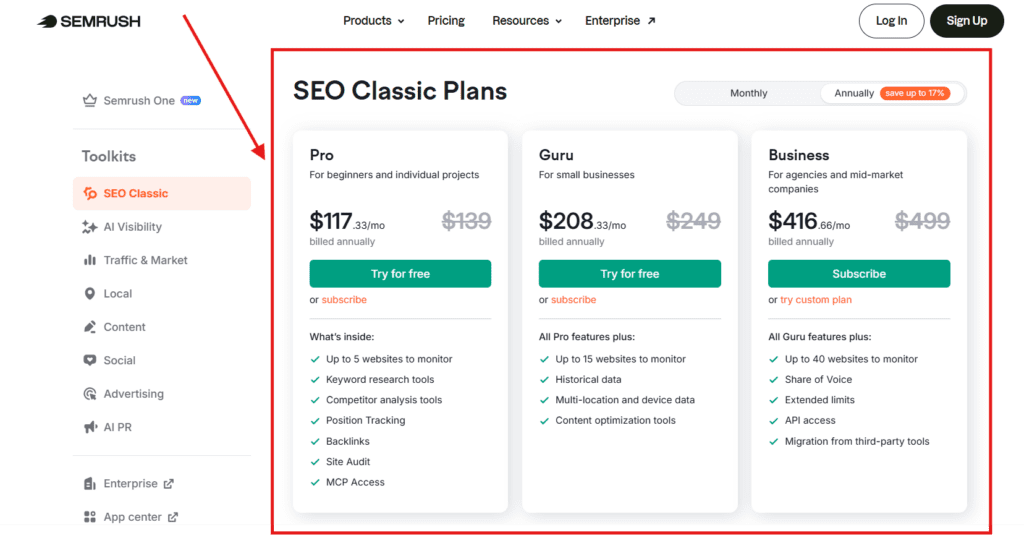
1. The Pro Plan: $139.95/mo (The Solopreneur’s Ceiling)
The Pro plan is designed for the Do-It-Yourself marketer. If you are a niche site builder or a small business owner with one or two websites, this is your home.
- The Practical Purpose: It is a research tool. It’s built for the person who wants to find out what their competitors are doing and track their own progress.
- The Reality of the 5-Project Limit: In Semrush, a Project is an active slot. If you have 3 of your own sites and you want to do a Site Audit for 3 potential clients, you can’t. You’ll have to delete one of your own sites to make room. This is the first forced upgrade trigger.
- The Historical Data Wall: This is the most painful limitation. On Pro, you cannot see how a website performed in 2023 or 2024. You only see the Live data. If you are trying to analyze if a competitor was hit by a Google Core Update two years ago, the Pro plan will keep you in the dark.
- Action: If you’re a solo founder, the Pro plan is the best place to start. You can test the Pro features here to see if it fits.
2. The Guru Plan: $249.95/mo (The Content Factory)
This is the most popular plan, and for good reason—it’s where the Magic happens for content teams.
- The Historical Data Unlock: Suddenly, the lights turn on. You can travel back in time to see seasonal trends from years ago. For an SEO professional, this is the difference between guessing and knowing.
- The Content Marketing Toolkit: This is the primary reason people upgrade. It includes the SEO Writing Assistant (SWA). If you have a team of freelance writers, you can send them a link to a Semrush-optimized Google Doc. It tracks their SEO score as they write.
- The Limit Reality: 15 projects and 1,500 keywords. For a mid-sized agency, this is usually enough to handle 10-12 active clients comfortably while leaving 3 slots for prospecting (auditing new potential clients).
- Action: To start optimizing your drafts in real-time, you’ll need to explore the Guru Plan options.
3. The Business Plan: $499.95/mo (The Enterprise Engine)
If you aren’t making at least $10,000/month from SEO services, you probably don’t need this.
- API Access: This is for the tech-heavy agencies who want to pull Semrush data into their own custom-built dashboards or proprietary software.
- Share of Voice (SoV): This is a 2026 must-have for big brands. It calculates how much digital shelf space you own. If someone searches for Luxury Watches, SoV tells you that you own 12% of the total market attention compared to your competitors.
- Free PLA (Product Listing Ads) Research: Essential for E-commerce giants. If you are managing a massive Shopify or Magento store and spending $50k/month on Google Shopping, this plan pays for itself by spying on competitor ad spends.
The Secret Annual Math
Semrush offers a roughly 17% discount if you pay annually.
- Pro Annual: ~$1,404/year (Saves you ~$275)
- Guru Annual: ~$2,499/year (Saves you ~$500)
Expert Tip: Do not buy the annual plan on Day 1. Start with a monthly Pro account. Use it for 30 days. See if you actually hit the limits. If you find yourself using it every single day, then—and only then—commit to the annual plan. That $500 saving on the Guru plan is only a saving if you actually use the tool for all 12 months.
For the latest official details and any seasonal promotions, you can check the official Semrush pricing page.
7 Semrush Pricing Secrets
Secret 1: The User Seat Multiplier Trap
This is the single biggest hidden cost in Semrush. Unlike some SEO tools that allow multiple logins (or have a more generous seat policy), Semrush charges per head.
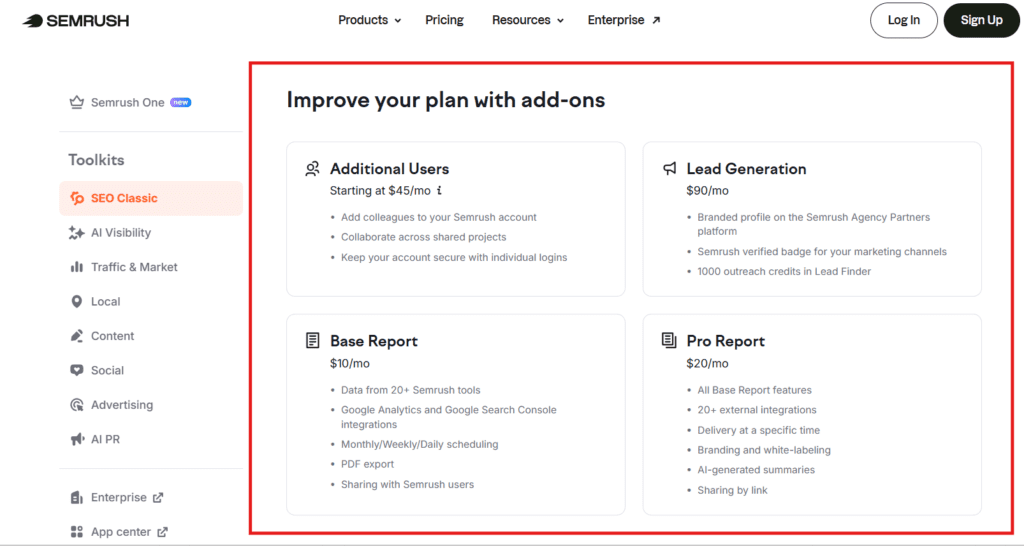
In 2026, the cost per user scales aggressively based on your plan:
- Pro Plan: +$45/mo per user
- Guru Plan: +$80/mo per user
- Business Plan: +$100/mo per user
The Math: If you are on the Guru Plan ($249.95) and you have a team of 3 SEOs who all need their own accounts, your bill isn’t $250. It’s $249.95 + $80 + $80 = $409.95/mo.
Insider Tip: If you have a larger team, check out the new Semrush One enterprise-style bundles. Sometimes moving to a higher base tier is cheaper than stacking $100/mo seats on a lower plan.
Secret 2: The .Trends Add-on (The High-Stakes Spy Tool)
You’ll see a tool called “.Trends” (Traffic Analytics & Market Explorer). It looks amazing in the demos—it shows exactly where Amazon gets its traffic or what age group shops at a competitor’s store.
- The Cost: $289/month.
- The Secret: This costs more than the Guru plan itself. Unless you are a media buyer or a VC firm doing due diligence, you can get 70% of this value using the free version of SimilarWeb or the basic Domain Overview already included in your plan. Don’t buy this add-on unless your job title starts with Market Research Analyst.
Secret 3: The Local SEO Tax
Semrush 2026 has doubled down on Local SEO. They now offer two distinct packages for businesses that rely on Google Maps:
- Local Base ($20–$30/mo): Distributes your info to directories.
- Local Premium ($40–$60/mo): Adds review management and Map Rank Tracker.
- The Secret: If you only have one location, paying $60/mo on top of your $140 Pro plan is steep. For many, managing your Google Business Profile (GBP) manually and using a cheaper, dedicated local tracker like BrightLocal can save you $300/year.
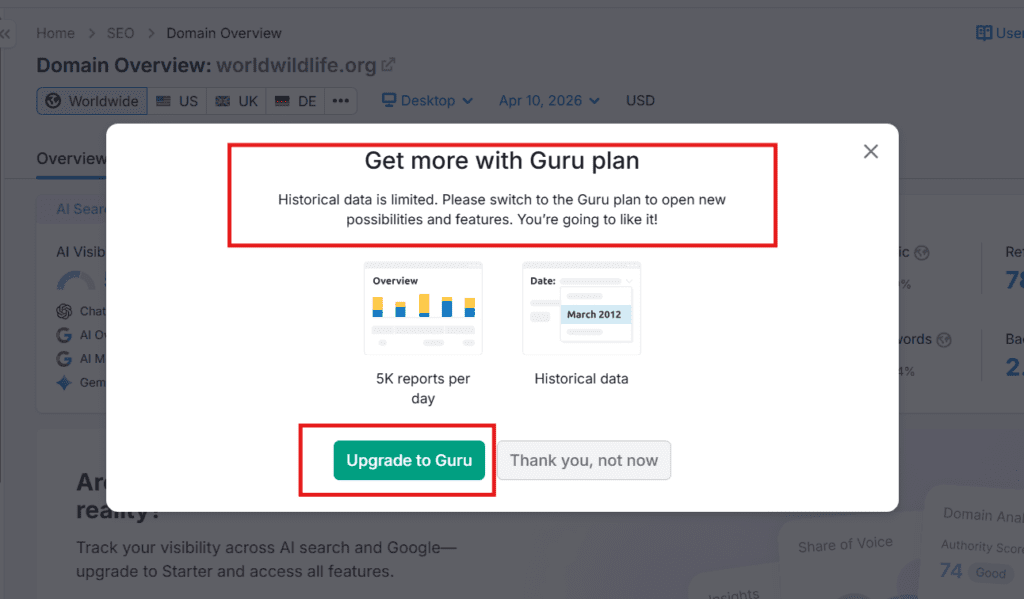
Secret 4: The Historical Data Paywall is 12 Months Deep
Semrush Pro gives you now. Guru gives you then. But here is the nuance: In 2026, the Pro plan actually lets you see some data from the last 12 months, but nothing beyond that. If you need to analyze how a site performed during a Google Update in 2023 or 2024, you must have Guru. If you’re just tracking your own growth from today forward, save the $110/month and stay on Pro.
The Secret: If you only have one location, paying $60/mo on top of your $140 Pro plan is steep. For many, managing your Google Business Profile (GBP) manually and using a cheaper, dedicated local tracker like BrightLocal can save you $300/year.
Secret 5: The AI Visibility Toolkit
With the rise of ChatGPT and Google’s AI Overviews (SGE), Semrush launched the AI Visibility Toolkit ($99/mo).
- It tracks if your brand is being cited by AI bots.
- The Secret: For most niche sites, this is currently over-optimization. Unless you are a massive brand (like Nike or Samsung) concerned with brand sentiment in AI models, you don’t need to pay an extra $1,200/year for this yet.
Secret 6: Keyword Metric Updates vs. Position Tracking
Most people think Keywords in Semrush are one thing. They aren’t.
- Position Tracking: These are the keywords you own and track every day (500 in Pro, 1,500 in Guru).
- Keyword Metric Updates: This is how many times you can click the Refresh button on new keyword ideas in the Keyword Manager.
The Trap: Pro only allows 250 updates per month. If you are doing heavy keyword research for a new silo, you will hit this limit in 48 hours.
The Solution: Use the Keyword Magic Tool for broad research and only add the finalists to your Keyword Manager to save your update credits.
Secret 7: The Project Parking Strategy
You get 5 projects on Pro. A project includes your Site Audit and Rank Tracking.
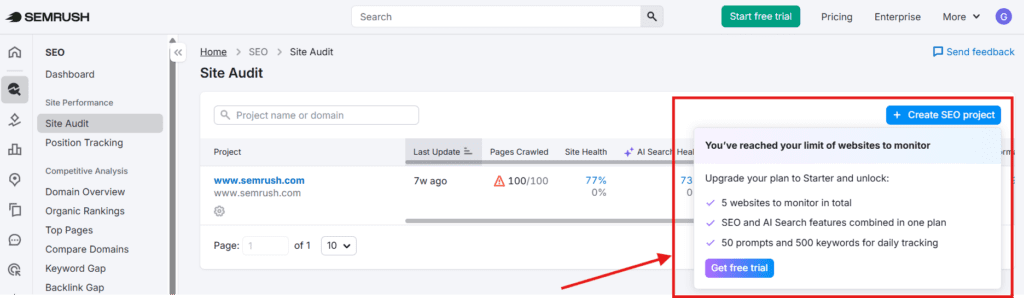
The Secret: If you finish a site audit for a client, you can export the PDF and delete the project. This frees up a slot for a new client. You only need to keep a project Active if you are tracking rankings daily. Many users upgrade to Guru ($250) just because they have 6 clients, but they could easily stay on Pro ($140) by rotating their project slots.
Detailed Limit Comparison: Pro vs. Guru vs. Business 2026
| Feature | Pro ($139.95) | Guru ($249.95) | Business ($499.95) |
| Projects | 5 | 15 | 40 |
| Tracked Keywords | 500 | 1,500 | 5,000 |
| Pages to Crawl/Mo | 100,000 | 300,000 | 1,000,000 |
| Historical Data | No (Limited) | Yes (Full) | Yes (Full) |
| Content Toolkit | No | Yes (Full) | Yes (Full) |
| API Access | No | No | Yes |
| Looker Studio | No | Yes | Yes |
Ready to pick? Compare all plan features side-by-side on the official checkout page.
Case Study: The Accidental Overspender
Meet Flow Digital, a small agency with 8 clients and 2 employees.
- Initial Setup: They bought the Guru Plan ($250) + 1 Extra User Seat ($80). Total: $330/mo.
- The Mistake: They also subscribed to the Local SEO Premium for 5 clients ($200/mo) and the .Trends add-on ($289/mo).
- The Bill: $819/month.
- The Audit: We realized they only used .Trends once every three months for pitch decks. We also moved their Local SEO to a cheaper manual workflow.
- The Result: We cut their bill from $819 down to $330. That’s nearly $6,000 a year in pure profit added back to the agency.
Semrush vs. Ahrefs: The 2026 Price-to-Value War
If you ask an SEO veteran which tool is better, they’ll likely say, Ahrefs for links, Semrush for everything else. But in 2026, the decision is dictated by Credits vs. Limits.
The Ahrefs Pay-Per-Click Problem
Ahrefs has moved almost entirely to a credit-based system.
- The Reality: Every time you open a report, apply a filter, or even click Next Page on a keyword list, you consume a credit. For a power user who spends 4 hours a day researching, those Lite or Standard credits can vanish in 10 days.
- The Semrush Advantage: Semrush still uses a Request-based system. On the Pro plan, you get 3,000 reports per day. You can click Filter 50 times on the same report, and it doesn’t cost you extra. This makes Semrush much more budget-friendly for exploratory research where you don’t know exactly what you’re looking for yet.
The Backlink Gap
Ahrefs used to be the undisputed king of backlinks. In 2026, while Ahrefs still maintains a slightly higher number of “Referring Domains, Semrush has surpassed them in Total Backlink Count (43 trillion vs 35 trillion).
- The Verdict: If you are a Link Building Specialist whose entire job is manual outreach, Ahrefs is still worth the premium. But for 95% of marketers, Semrush’s backlink data is now good enough that paying for both tools is a waste of money.
When Semrush Is NOT Worth Your Money
I’m an expert user, but I’ll be the first to tell you to close the tab if you fall into these categories:
1. The Pre-Revenue Blogger
If your blog is making $0 and you have $200 in your bank account, do not buy Semrush. SEO takes 6–12 months to show results. If you buy Semrush now, you’ll spend $1,500 before you even see your first affiliate commission.
- Better Path: Use Google Search Console (Free) and a tool like Mangools or Ubersuggest (significantly cheaper) until you hit 10,000 visitors per month.
2. The Backlink Only Specialist
If you only care about checking who linked to your competitor and you don’t care about site audits, PPC research, or content tracking, Semrush is too bloated for you. You’re paying for a Swiss Army knife when you only need a toothpick.
3. High-Team-Count Agencies on a Budget
If you have a team of 10 people and everyone needs a login, Semrush will bankrupt you. With user seats costing up to $100/mo each, a 10-person team on Guru would cost over $1,000/month.
- The Alternative: Look at SE Ranking. In 2026, SE Ranking offers much more generous multi-user seats for a fraction of the cost. You sacrifice some data depth, but you save $8,000 a year.
In the world of 2026 SEO, a “Pros” isn’t just a button you click; it’s a way to save four hours of manual work. A “Cons” isn’t just a high price; it’s a bottleneck that might stop you from scaling.
Honest Pros and Cons (2026 Experience-Driven Table)
| Category | The Winning Pros (Why it’s worth the check) | The Frustrating Cons (The reality check) |
| Data & Insights | Unrivaled Competitive Intelligence: You can see a competitor’s Search Intent profile (Informational vs. Transactional), which is the most accurate in the market. | Google-Centric Bias: If you’re looking for deep data on Bing, DuckDuckGo, or Amazon, Semrush is significantly weaker. It’s a Google-first tool. |
| Workflow Efficiency | The All-In-One Ecosystem: Replaces your SEO tracker, PPC spy tool, and Social Media scheduler. Managing one invoice instead of four is a massive mental win. | The “Learning Cliff”: With 55+ tools, the UI is cluttered. A beginner will spend their first $140 just trying to find where the Backlink Audit is hidden. |
| Limits & Scaling | Generous Reporting Requests: Unlike Ahrefs’ credit system, you can refresh filters on a report 100 times without paying extra. Perfect for deep-dive research. | The “User Seat” Tax: Only one login per account. Adding a second person is a brutal +$45 to +$100/mo. It punishes small teams who aren’t yet ready for Enterprise pricing. |
| Content Strategy | SEO Writing Assistant (Guru+): Real-time feedback on your Google Docs for SEO, readability, and tone. It’s like having a senior editor sitting next to you. | AI Credits Nickeling: While AI is integrated, high-volume AI writing often requires extra credits or a separate add-on subscription, which can feel like an upsell. |
| Reporting | Visual Storytelling: Their PDF reports are beautiful. You can send them to a client and they look like they were custom-designed by a $100/hr designer. | Add-on Fatigue: Want Traffic Analytics or Local Maps tracking? That’s another $20–$289/mo. The Base price is rarely the Final price for a power user. |
Why the Cons Matter
I want to be very blunt here: The biggest Cons isn’t the price; it’s Underutilization. Most marketers are essentially buying a Ferrari to drive in a school zone. They pay for the Guru plan ($249.95) but never touch the Content Audit or the Link Building Management tool.
If you aren’t going to use the specific features that justify the price jump—like Historical Data to analyze past algorithm hits or Looker Studio to automate your client reporting—then that $110 monthly difference is a 100% loss for your business. In a year, that’s $1,320 you could have spent on quality backlinks or content.
The Gym Membership Strategy: Treat Semrush like a gym. If you aren’t going to work out (log in) at least three times a week and break a sweat with the data, don’t buy the Personal Trainer (Guru/Business) package yet. Stick with the Basic (Pro) until you are consistently hitting the limit walls.
Practical Tips to Save Money Today
- The Annual Buffer: If you can’t afford the $1,400 annual payment upfront, put $120 into a separate savings account every month. By month 12, you’ll have the cash to switch to annual and earn 2 months for free.
- Audit Your Tracked Keywords: Most people track keywords they already rank #1 for. Stop. Track the keywords where you are on Page 2 (Rank 11-20). These are the only ones that matter for your growth. This keeps you under the 500-keyword limit of the Pro plan.
- Use the Share Feature Wisely: Instead of buying a $80 user seat for a client, use the PDF Scheduling feature. You can send them a beautiful, automated report every Monday morning. They get the data they need, and you don’t have to pay for an extra login.
FAQ: Frequently Asked Questions
Q: Can I use Semrush for Free?
Yes. You get 10 searches per day. For a very small hobby site, this is actually plenty. Don’t upgrade until you find yourself getting blocked by the Limit reached popup every single day.
Q: Is the Guru plan better for AI content?
Yes. The Guru plan gives you access to the SEO Writing Assistant. If you use AI to write content, this tool is vital because it tells you if your AI-generated text is too”robotic or lacks the keywords needed to rank.
Q: What is Semrush One?
This is a new 2026 track that combines the SEO toolkit with brand-new AI Visibility tools. It’s slightly more expensive but includes features for tracking your brand mentions in ChatGPT and Gemini answers.
Final Verdict: The Direct Recommendation
At BizSmartTools, our mission is to help you cut through the SaaS noise and invest only in what grows your business. After dissecting the 2026 updates, here is our direct stance:
- Buy the PRO Plan ($139.95) if: You are a freelancer or solo blogger. You need a professional-grade brain for your SEO but don’t need to look at data from 3 years ago.
- Buy the GURU Plan ($249.95) if: You are a growing agency or a content-heavy business. The Historical Data and Content Toolkit will pay for themselves by helping you win better clients and write faster.
- Buy the BUSINESS Plan ($499.95) if: You are managing an Enterprise-level site (1M+ pages) or you need to pull data into your own custom apps via API.
Expert Advice: Don’t let “Limit Panic” slow you down. Start with the lowest plan possible and choose your Semrush plan based on current needs, not future fears.
The Expert Advice from BizSmartTools: Semrush is an investment, not an expense. If you use it to find just one high-value keyword that brings in a $2,000 client, the tool has paid for itself for the entire year. Don’t fear the price—fear the “Waste.” Stay on the lowest plan possible until your business forces you to upgrade.
Internal Linking & Resources
- Learn the Basics: The Ultimate Beginner to Pro Guide to Using Semrush
- Master the Strategy: Beginner Semrush SEO Strategy & Workflow
- Explore Other Options: 10 Best SEO Tools in 2026
0 Comments