






Why Most Beginners Fail (and How You Won’t)
You have probably heard that Content is King. So you wrote great content. You have heard that Backlinks are Queen. So you tried to get some links. Yet, your traffic graph looks like a flatline.
The harsh truth? In 2026, Google does not reward good content. It rewards strategic content. If you are a beginner, you are competing against sites with million-dollar budgets and decades of authority. You cannot win by working harder; you have to win by working smarter. This is where Semrush acts as your unfair advantage. It shows you the gaps in the market where the big players are sleeping.
In this massive guide, we are going to break down the exact workflow used by top SEO agencies. We will go deep into the why and how of every button in Semrush. By the end of this, you won’t just know SEO, also you will be ready to execute a professional-grade strategy.
If you’re just getting started with SEO, check out our Beginner to Pro Guide to Using Semrush.
1. Understanding the Semrush Ecosystem
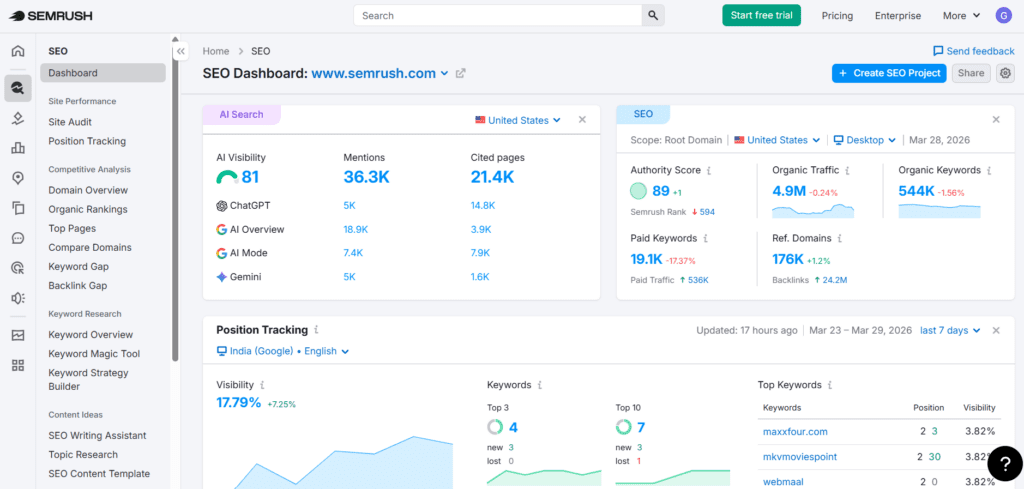
Before we touch the tools, let’s simplify the beast. Semrush is divided into Toolkits. As a beginner, you only need to master three:
- SEO Toolkit: For rankings and technical health.
- Content Marketing Toolkit: For writing things people actually want to read.
- Competitive Research Toolkit: For spying on your rivals.
Real Use Case: Imagine you are starting a blog about Pet Training. You don’t just start writing. You use the Competitive Research Toolkit to see that How to stop a puppy from biting is a high-traffic topic, but your competitors have old, outdated videos. That is your entry point.
Step 1: The “Low-Hanging Fruit” Keyword Research
Keyword research is where 90% of beginners fail. They pick keywords that are too broad “Dog Food” or keywords no one searches for “My dog’s favorite organic kibble brand“.
A. The Seed Keyword Phase
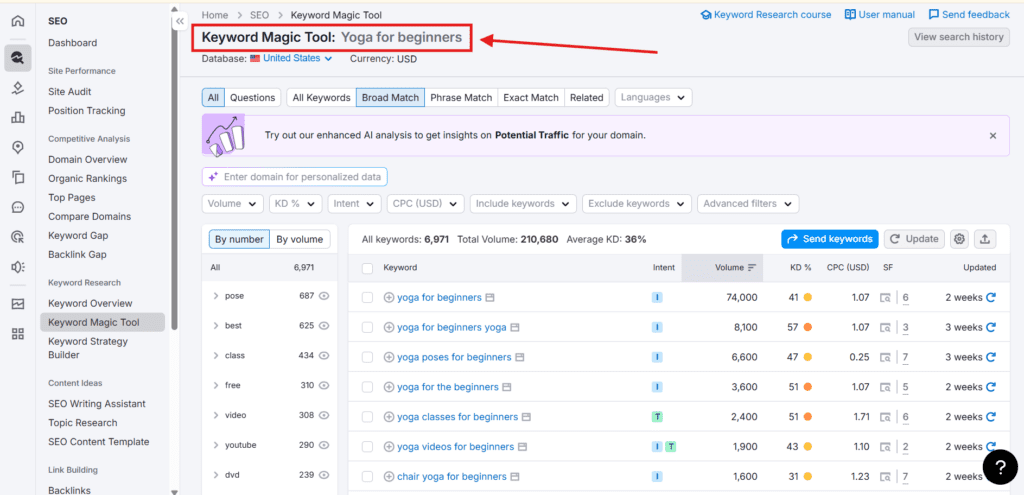
Go to the Keyword Magic Tool. This tool has a database of over 25 billion keywords. Start with a Seed—a broad term like “Yoga for beginners.”
B. Mastering the Filters (The Secret to Ranking)
This is the most important part of the workflow. If you skip this, you will never rank.
- Keyword Difficulty (KD%): This is a score from 0 to 100.
- 0-14 (Very Easy): Your best friend. You can rank here with just good content.
- 15-29 (Easy): You might need 1 or 2 small backlinks.
- 30-49 (Possible): Hard for a brand-new site.
- Action: Set your filter to Max 29%.
- Intent: Semrush now categorizes keywords by why the user is searching.
- Informational (I): “How to do a crow pose” Use these for blog posts.
- Commercial (C): “Best yoga mats for sweaty hands” Use these for “Top 10” listicles.
- Transactional (T): “Buy Manduka yoga mat” Use these for product pages.
C. Finding The Gap via Questions
Click the Questions button. Questions are the easiest way to get into the Featured Snippet (Position 0 on Google).
- Example: “Can I do yoga with a wrist injury?”
- This is a specific problem. If you answer this better than anyone else, you win the click.
D. Understanding “Search Volume” vs. “Value”
Don’t be fooled by high volume. A keyword with 100 searches but High Commercial Intent (people ready to buy) is worth more than a keyword with 10,000 searches that is just General Info.
Beginner Mistake: Ignoring LSI (Latent Semantic Indexing) Keywords. These are related terms. If you write about “Yoga,” Google expects to see words like “Mat,” “Breath,” “Flexibility,” and “Pose.” Semrush’s Keyword Magic Tool shows these in the left-hand sidebar. Use them!
Step 2: The Competitor Heist Strategy
Why spend months testing what works when your competitors have already spent the money for you?
A. Domain Overview: The X-Ray
Enter your competitor’s URL. Look at their Top Organic Keywords.
- The Workflow: Find a keyword they rank for in positions 4-10. These are their weak spots. If you write a fresher, longer, and more visual article, you can bump them and take that traffic.
B. The Keyword Gap Tool
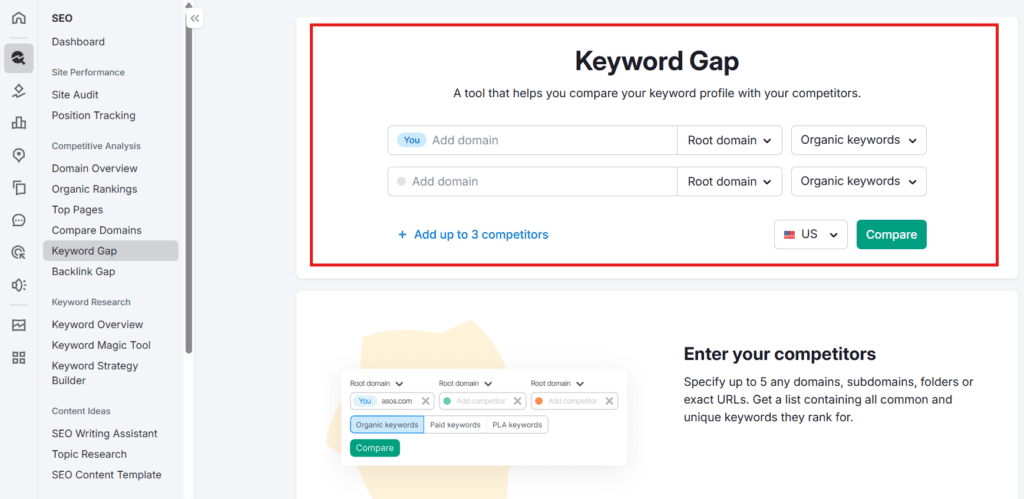
This tool is pure gold.
- Enter your site URL.
- Enter your top 3 competitors.
- Click Compare.
- Filter by Missing: These are keywords all your competitors rank for, but you have zero content for. This is your Content Roadmap for the next 3 months.
C. Backlink Gap: Who is Supporting Them?
If a high-authority site like Forbes or The Spruce links to your competitor, they have a vote of trust.
- Action: Use the Backlink Gap tool to find sites that link to multiple competitors but not you. These sites are Industry Hubs. Reach out to them and introduce your brand.
Step 3: Creating Topical Authority
Google no longer ranks pages; it ranks sites that know their stuff. If you write one post about Keto Diet and then one about Bitcoin, Google thinks you are a jack-of-all-trades and master of none.
A. The Pillar-Cluster Model
Use the Topic Research Tool.
- Type in Keto Diet. Semrush will show you a Mind Map of sub-topics.
- The Strategy: Create one Pillar Page (The Ultimate Guide to Keto). Then create 10 Cluster Pages (Keto Breakfast, Keto for Seniors, Keto Side Effects).
- Internal Linking: Link every cluster page back to the Pillar. This tells Google: I have covered every corner of this topic. I am an Authority.
B. Content Audit
If you already have articles, use the Content Audit tool. It tells you which posts are Healthy, which need a Rewrite, and which should be Deleted.
- Expert Tip: Sometimes, deleting 10 low-quality posts and merging them into 1 Super Post will double your traffic overnight.
Step 4: On-Page SEO: The No-Code Optimization
You don’t need to be a coder to do On-Page SEO.
A. SEO Writing Assistant (SWA)
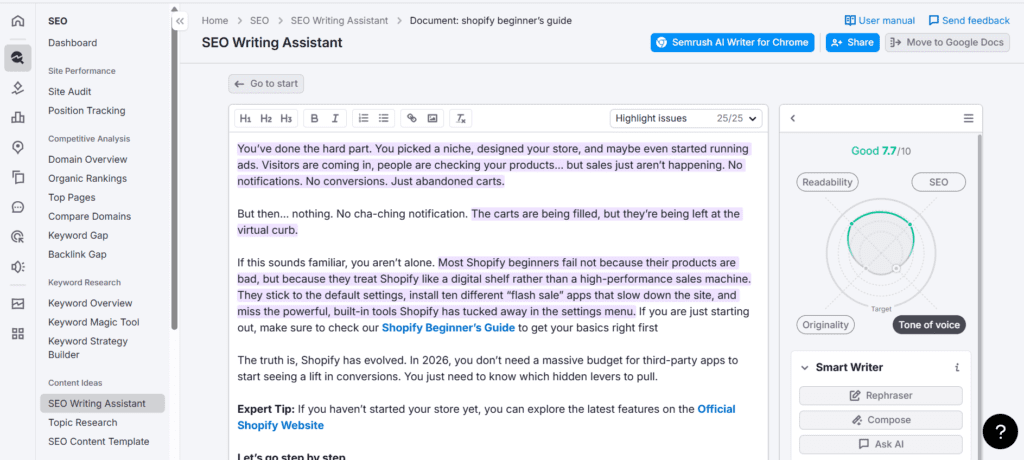
When you are writing in Google Docs or WordPress, the SWA plugin works in real-time.
- Target Keywords: It tells you if you’ve used your main keyword enough (or too much).
- Tone of Voice: Is your writing too formal? Too casual? It keeps you consistent.
- Readability: It highlights sentences that are too hard to read. Rule of thumb: Write at a 7th-grade level.
B. On-Page SEO Checker: The To-Do List
- Semantic Ideas: Add these 5 related words to rank higher.
- User Experience: Your page takes too long to load on mobile.
- Content Ideas: Your competitors have longer articles; add 500 more words.
Once a page is live, run it through this tool. It will give you specific Ideas:
Beginner Mistake: Optimizing for robots, not humans. If your text is unreadable because you forced too many keywords in, people will leave (high bounce rate), and Google will drop your rankings anyway.
Step 5: Technical SEO: The Site Audit
This is the medical checkup for your website.
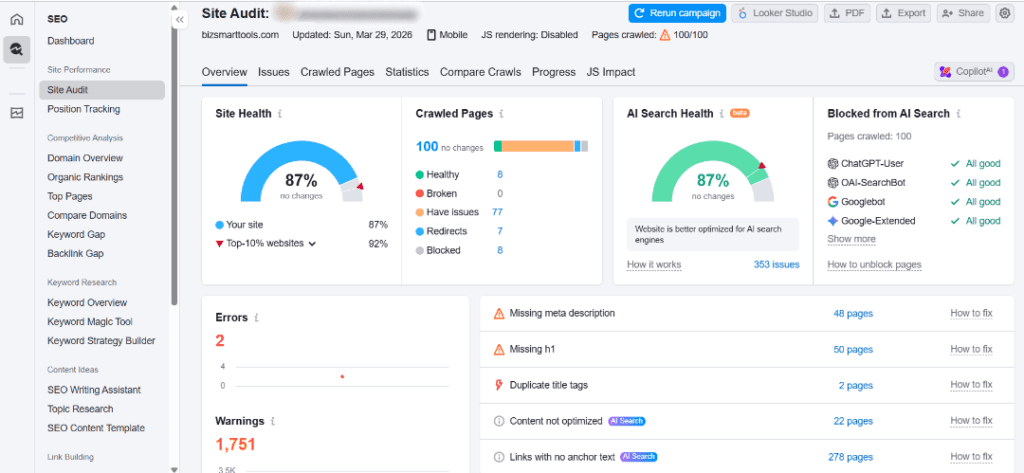
A. Running the Audit
Set up a Site Audit project. Semrush will crawl your site like Google does.
B. The Priority System
Don’t try to fix everything at once.
- Errors (Red): These are critical. Broken links, redirect loops, or “No-index” tags that hide your site from Google. Fix these immediately.
- Warnings (Orange): Missing Alt-tags or duplicate meta descriptions. Fix these when you have time.
- Notices (Blue): Minor things like External link with nofollow. Usually safe to ignore at first.
C. HTTPS & Security
Semrush will tell you if your SSL certificate is expired or if you have Mixed Content (loading insecure images on a secure site). Google hates insecure sites. This is a top priority.
Step 6: Tracking Your Success
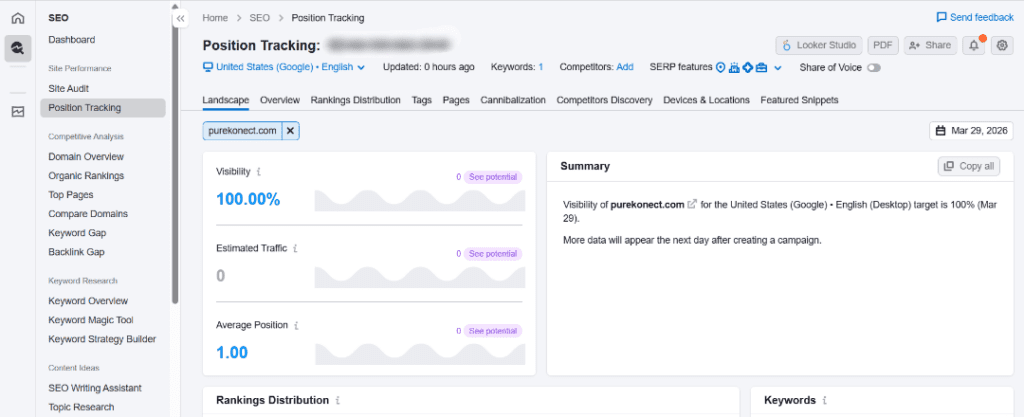
SEO takes time, but you need to see progress to stay motivated.
A. Position Tracking
Add your top 50 keywords to the Position Tracking tool.
- The Visibility Score: This shows you what percentage of the total search market you own.
- Competitor Tracking: You can see if your competitor is gaining on you or if you are winning the race.
B. Google Looker Studio Integration
If you are working for a client or want a clean report for yourself, Semrush integrates with Looker Studio to create beautiful, automated dashboards.
Real Case Study: The Newbie Niche Site Success
Niche: Sustainable Living.
Problem: The owner was writing 3 posts a week but getting 0 traffic for 4 months.
The Semrush Intervention:
- Keyword Research: We found that they were targeting How to live sustainably (KD 70). We switched them to Biodegradable sponges for kitchen (KD 12).
- Site Audit: Found that their Home button was broken on mobile. Fixed it.
- Competitor Analysis: We saw a competitor was ranking for Eco-friendly baby gifts with a very short post. Then we wrote a 25 Best Eco-friendly Baby Gifts guide.
- Result: Within 90 days, the site went from 150 visitors to 8,000 visitors per month. The owner finally made their first $100 in affiliate commissions.
Common Mistakes Beginners Make
- Ignoring Search Intent: Writing a blog post for a keyword where Google only shows Product Categories.
- Not Setting Up a Project: If you do not set up a Semrush Project, you miss out on automated tracking and audits.
- Chasing Dofollow Links only: Nofollow links (from social media or forums) still bring traffic and make your link profile look natural.
- Forgetting the Meta Description: If your meta description is boring, no one will click, even if you are rank #1.
When to Use Semrush
Semrush is a pro tool. It costs money.
- Use it if: You are treating your website like a business. It will save you hundreds of hours of manual work.
- Do not use it if: You just want to write a personal diary for fun.
FAQs
1. Is Semrush accurate?
It is the most accurate tool in the market, but remember: only Google knows the exact numbers. Semrush gives you the best possible estimate.
2. Can I use it for YouTube SEO?
Yes! The Keyword Magic Tool has a Video filter to see which keywords trigger video results on Google.
3. How do I find Low Competition keywords quickly?
Use the Keyword Magic Tool, set KD to <20%, and sort by Volume (High to Low).
4. What is the Social Tracker?
It’s a bonus tool that tracks your competitor’s social media growth. Useful for seeing which of their posts are going viral.
5. Do I need an SEO agency if I have Semrush?
For a beginner/medium site? No. Semrush is your agency. It tells you exactly what to do.
Conclusion: Start Before You Are Ready
SEO feels like a mountain, but you do not have to climb it in one day.
Your First 24-Hour Mission:
- Start a Semrush Trial.
- Enter your URL in Site Audit. Fix the first 3 Red Errors.
- Find one keyword with KD < 15% and Volume > 200.
- Write a 1,500-word post answering that keyword’s question perfectly.
That is how websites are built. One data-backed decision at a time. Stop guessing. Start ranking.
Don’t leave your traffic to chance. Start your Semrush journey today!

0 Comments