






If you’re planning to start an online store in 2026, one of the biggest decisions you’ll make is choosing the right eCommerce platform. The debate around Shopify vs WooCommerce is everywhere — but beginners often get confused by mixed opinions.
Some say Shopify is easier.
Others say WooCommerce is cheaper.
Many claim one is “more profitable.”
But which one actually makes more sense for beginners in 2026?
Both platforms are powerful. Both can build professional online stores. And both are used by successful businesses worldwide.
The real question is not which platform is “better” in general — but which one is better for your budget, skill level, and long-term goals.
The honest answer: profit doesn’t depend only on the platform. It depends on:
- Costs
- Fees
- Conversion rates
- Marketing
- Store management efficiency
That means no platform automatically makes you rich.
Shopify is not a profit machine.
WooCommerce is not a money saver by default.
Your real profit comes from how well you control expenses and generate sales.
What This Guide Covers
In this detailed, beginner-friendly guide, we’ll break down:
- Shopify pricing 2026
- Complete WooCommerce cost breakdown
- Hidden costs most beginners ignore
- Real profit calculation example
- Ease of use comparison
- Customization differences
- SEO comparison
- Scalability comparison
- Conversion rate factors
- Detailed pros and cons tables
- Final beginner recommendation
Let’s start from the foundation.
What is Shopify?
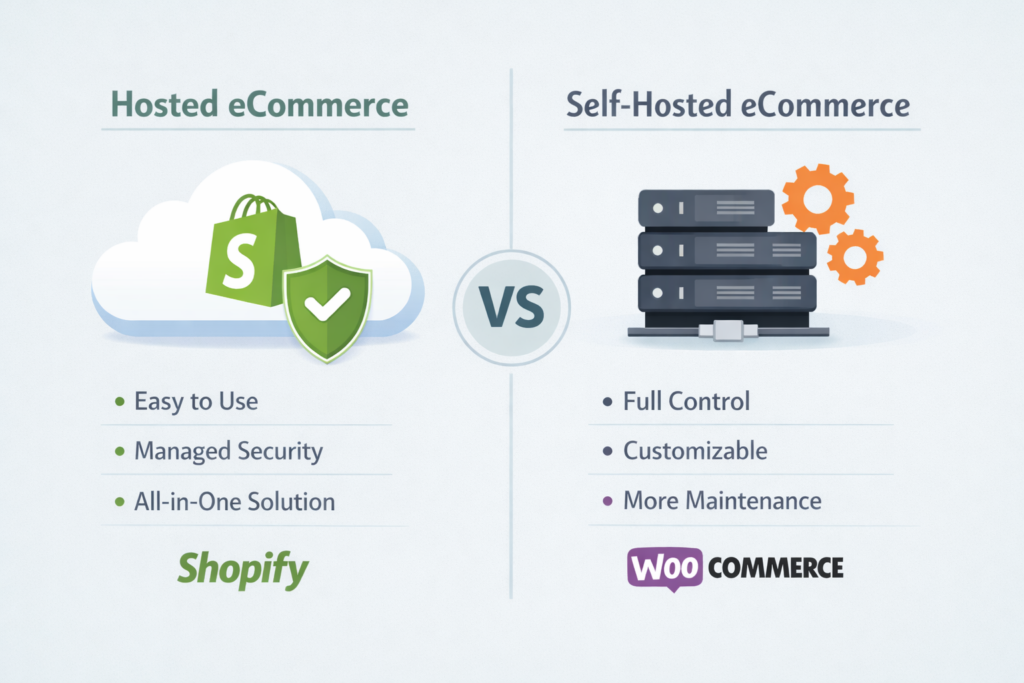
Shopify is a fully hosted eCommerce platform. That means everything technical is handled for you:
- Hosting included
- SSL certificate included
- Security managed
- Automatic updates
- Built-in payment system
- Optimized checkout system
You create an account, choose a theme, upload products, and start selling.
Why Beginners Choose Shopify
- Very easy to set up
- Clean dashboard
- No coding required
- 24/7 customer support
- Fast launch time
Shopify removes technical complexity so beginners can focus on marketing and sales.
What is WooCommerce?
WooCommerce is a free WordPress plugin that turns a WordPress website into an online store.
Unlike Shopify, WooCommerce is self-hosted.
That means:
- You must purchase hosting
- Install WordPress
- Manage updates
- Handle backups
- Secure your site
- Optimize performance
WooCommerce gives you more control, but it also gives you more responsibility.
Shopify vs WooCommerce Market Share 2026
According to industry reports:
- WooCommerce powers a large percentage of online stores globally because it runs on WordPress.
- Shopify dominates hosted eCommerce solutions due to its simplicity.
This means:
- WooCommerce = flexibility + ownership
- Shopify = simplicity + managed infrastructure
Both are industry leaders — you’re not choosing a weak platform.
Shopify Pricing 2026 (Detailed Breakdown)
Understanding Shopify pricing 2026 is essential before calculating profit.
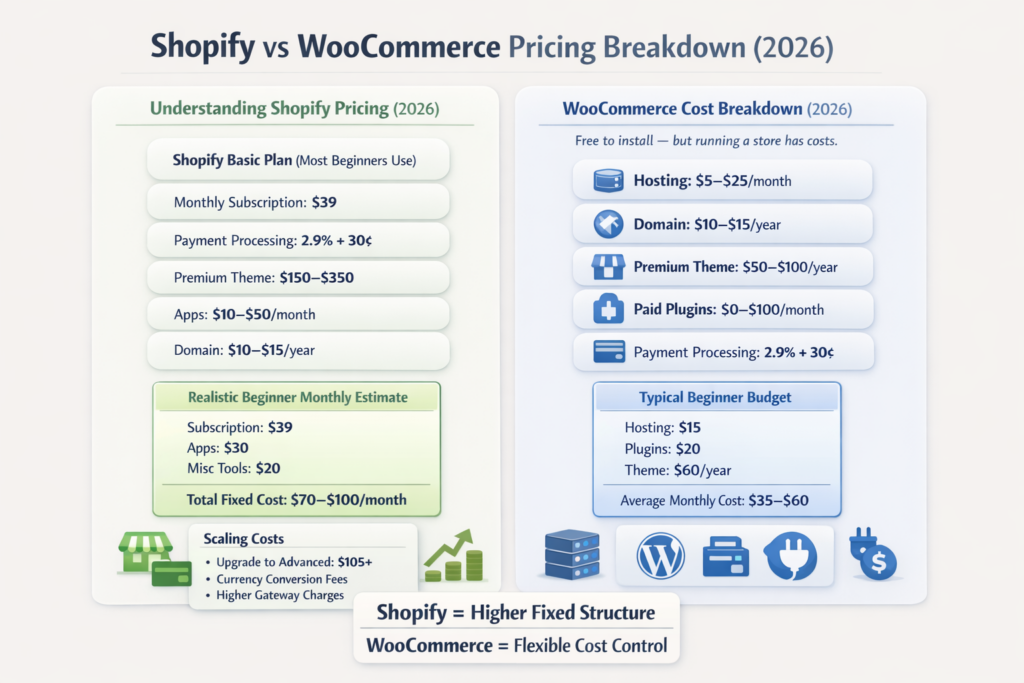
Shopify Basic Plan (Most Beginners Use)
| Cost Component | Estimated Cost |
| Monthly Subscription | $39/month |
| Payment Processing | 2.9% + 30¢ |
| Premium Theme | $150–$350 |
| Apps | $10–$50/month |
| Domain | $10–$15/year |
Realistic Beginner Monthly Estimate
- Subscription: $39
- Apps: $30
- Misc tools: $20
Total fixed cost: $70–$100 per month
If revenue grows beyond $20,000/month:
- Upgrade to Advanced plan ($105+)
- Currency conversion fees
- Higher gateway charges
Scaling increases fixed cost.
WooCommerce Cost Breakdown 2026
WooCommerce is free — but running a store is not.
WooCommerce Cost Structure
| Cost Component | Estimated Cost |
| Hosting | $5–$25/month |
| Domain | $10–$15/year |
| Premium Theme | $50–$100/year |
| Paid Plugins | $0–$100/month |
| Payment Processing | 2.9% + 30¢ |
Typical Beginner Budget
- Hosting: $15
- Plugins: $20
- Theme: $60/year
Average monthly cost: $35–$60
Types of Hosting
- Shared Hosting (Cheap, slower under heavy traffic)
- Managed WordPress Hosting (Balanced option)
- VPS/Cloud Hosting (High traffic stores)
As traffic increases, hosting cost may grow to $50–$150/month.
Hidden Costs Most Beginners Ignore
Shopify Hidden Costs
- Advanced marketing apps
- Email automation tools
- Upsell apps
- Premium themes
- Extra transaction fees
WooCommerce Hidden Costs
- Security plugins
- Backup solutions
- Speed optimization tools
- Developer fees
- Time investment
Time = money.
Technical maintenance reduces marketing time.
Conversion Rate Comparison
Shopify Advantage
- Optimized checkout
- Mobile-first themes
- Built-in abandoned cart tools
- Fast loading infrastructure
WooCommerce Advantage
- Fully customizable checkout
- Advanced funnel building
- CRO flexibility
Even a 0.5% increase in conversion rate can impact revenue more than platform cost differences.
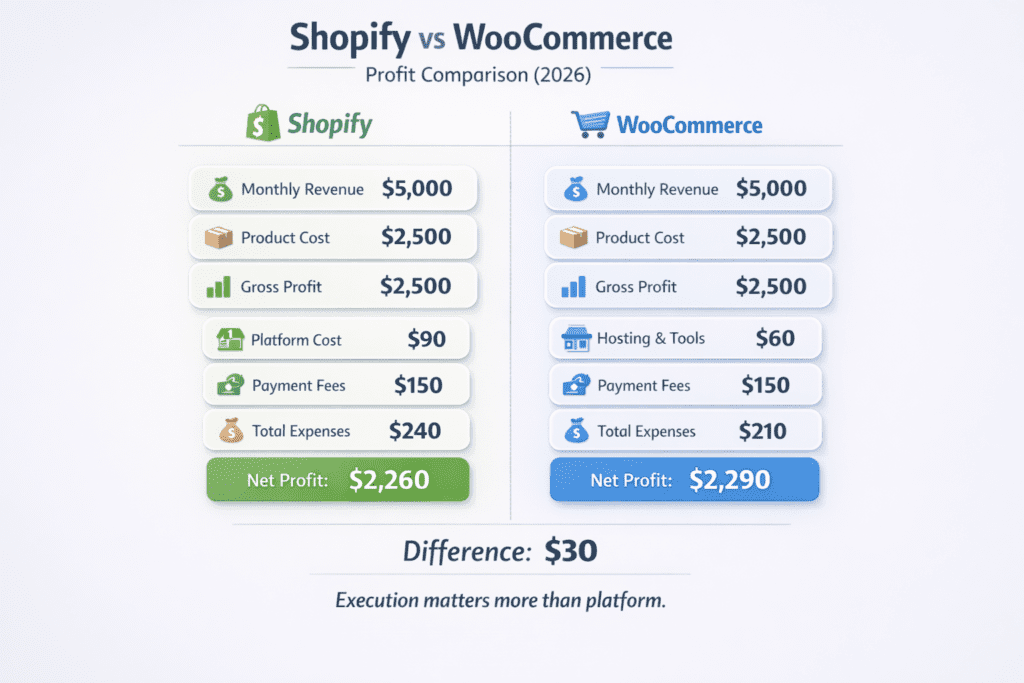
Shopify vs WooCommerce Profit Comparison
Assume:
- Monthly Revenue: $5,000
- Product Cost: $2,500
- Gross Profit: $2,500
Shopify Scenario
- Platform cost: $90
- Payment fees: $150
- Total Expenses: $240
- Net Profit: $2,260
WooCommerce Scenario
- Hosting & tools: $60
- Payment fees: $150
- Total Expenses: $210
- Net Profit: $2,290
Difference: $30
Execution matters more than platform.
Ease of Use Comparison
| Feature | Shopify | WooCommerce |
| Setup | Very Easy | Moderate |
| Hosting | Included | No |
| Updates | Automatic | Manual |
| Beginner Friendly | High | Medium |
| Technical Skill | Low | Medium |
Shopify reduces technical risk.
SEO Comparison
Shopify SEO
- Structured SEO
- Limited URL customization
- Fast performance
- App-based SEO tools
WooCommerce SEO
- Full URL control
- Advanced schema support
- Complete technical SEO control
- Plugin flexibility
If SEO is your main traffic strategy, WooCommerce offers more control.
Customization & Control
WooCommerce Offers:
- Full code access
- Unlimited customization
- Advanced SEO control
- Complete ownership
Shopify Offers:
- Structured customization
- App-based flexibility
- Limited backend editing
If control matters → WooCommerce wins
If simplicity matters → Shopify wins
Detailed Strengths & Weaknesses Tables
Shopify Strengths & Weaknesses
| Pros | Cons |
| Beginner-friendly | Monthly subscription |
| Hosting included | App costs |
| Reliable uptime | Transaction fees |
| 24/7 support | Limited backend control |
| Fast launch | Less server control |
WooCommerce Strengths & Weaknesses
| Pros | Cons |
| Free core plugin | Hosting setup |
| Full ownership | Security responsibility |
| Unlimited customization | Plugin conflicts |
| Strong SEO flexibility | Maintenance required |
| Lower base cost | Learning curve |
Quick Decision Table
| If You Want | Choose |
| Fast launch | Shopify |
| Full control | WooCommerce |
| No technical stress | Shopify |
| Deep customization | WooCommerce |
Which Platform is More Profitable for Beginners?
Choose Shopify if:
- You want fast setup
- You are non-technical
- You prefer predictable monthly costs
- You want 24/7 support
Choose WooCommerce if:
- You use WordPress
- You want full customization
- You’re comfortable managing hosting
- You want long-term flexibility
Profit depends on:
- Conversion rate
- Advertising efficiency
- Product margins
- Cost control
Final Thoughts
Both platforms are excellent in 2026.
Shopify provides:
- Simplicity
- Stability
- Predictable expenses
WooCommerce provides:
- Flexibility
- Ownership
- Customization
A well-managed Shopify store can outperform WooCommerce.
A well-optimized WooCommerce store can outperform Shopify.
Your strategy determines your success.
FAQs
1. Is Shopify easier for beginners?
Yes, Shopify is simpler to start with.
2. Is WooCommerce cheaper?
It can be, depending on hosting and plugins.
3. Which platform has lower fees?
Both charge similar payment processing fees.
4. Can WooCommerce handle large traffic?
Yes, with strong hosting.
5. Does Shopify include hosting?
Yes, hosting and security are included.
Call to Action
Still unsure which platform is right for you?
Evaluate:
- Your technical comfort
- Your monthly budget
- Your long-term business goals
Always Remember:
The best platform is not the most popular one — it’s the one you can manage confidently, scale consistently, and optimize efficiently over time. Both Shopify and WooCommerce can be profitable in 2026. The real difference comes from how well you plan your costs, improve conversions, and execute your marketing strategy. If you found this Shopify vs WooCommerce comparison helpful, explore more beginner-friendly eCommerce guides, cost breakdowns, and platform comparisons on BizSmartTools to build your online store the smart way in 2026.
Start smart. Grow strategically. 🚀
0 Comments